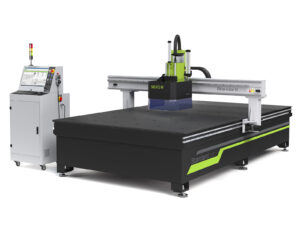

Milling Router

  • Pro+ Milling Router

    Pro+ Milling Router

    Ask for an offer
  • Pro Milling Router

    Pro Milling Router

    Ask for an offer
  • Machining Center Expert

    Expert Milling Router

    Ask for an offer
  • Expert+ Milling Router

    Expert+ Milling Router

    Ask for an offer

CNC milling plotters are advanced machines that are widely used across various industries. They enable precise machining of a wide range of materials using the CNC process – Computer Numerical Control, i.e. computer-controlled milling. This ensures high accuracy and repeatability of performed operations. Seron milling plotters are particularly useful in industries such as woodworking, metalworking, the advertising industry, furniture manufacturing, as well as the broadly understood engineering sector.

Computer-controlled milling plotter

Modern Seron milling plotters operate on the principle of precise material cutting using a rotating tool known as a milling cutter. This process is carried out according to a pre-programmed plan, making it easy and fast to achieve complex shapes and patterns with a minimal margin of error. Machine control is performed using specialized CAD/CAM computer software, which allows for the creation of two- and three-dimensional digital models and then converts them into control code understood by the plotter.

Precise machining of various materials

CNC milling plotters are versatile devices that can machine a wide range of materials. They are used to cut complex shapes in wood, as well as to manufacture custom-made furniture. A CNC milling plotter also performs excellently in machining materials such as acrylic (plexiglass), polycarbonate, aluminum, copper, as well as composites, including MDF boards. As a result, these machines are useful in the advertising industry, for example for creating signs and three-dimensional letters, as well as tools, metal parts, and structural components.

Seron milling plotter and production automation

Thanks to computer control, CNC plotters can perform highly accurate cutting and milling with minimal tolerances. This makes them an excellent solution for both mass production and single prototypes. The ability to easily change the machine’s operating program allows for quick adaptation to changing production needs. CNC technology enables the automation of production processes, which shortens machining time and minimizes the need for operator intervention. Automation allows for unattended operation over longer periods, resulting in higher productivity. As a result, the Seron milling plotter can meet the expectations of even the most demanding users.

FAQ

1. What are the operating and maintenance costs of a milling plotter?

Operating costs include energy consumption, tool replacement and sharpening, consumables, and servicing. Estimated monthly expenses may range from one to several thousand PLN per month, depending on the intensity of use and the machine model. Regular maintenance reduces the risk of costly failures and extends the machine’s service life. A CNC milling plotter also requires regular technical inspections, with costs starting from PLN 1,900 per inspection for machines from the Expert, Expert+, Pro, and Pro+ series.

2. What software is required to operate a milling plotter?

Operating a milling plotter requires CAD software for designing models and technical drawings. Next, CAM software is used to generate toolpaths and prepare files for the CNC machine. Popular solutions include Fusion 360, Cobus, Corpus, Vectric, Top Solid, Palettecad, Woodlab, and SolidWorks CAM, offering both design and machining capabilities. Additionally, a CNC controller is required to transmit data directly to the plotter.

3. What is a milling plotter used for?

A milling plotter enables precise cutting and milling of materials in two, three, four, or five axes. It allows the creation of shapes, patterns, and structural and decorative elements from various materials. It is a tool used in prototyping, single-unit production, as well as medium- and high-volume production. CNC plotters increase precision and efficiency compared to manual machining.

4. What materials are CNC milling plotters suitable for?

CNC plotters are used to machine solid wood, MDF boards, particle boards, plywood, and other wood-based materials. They can also work with plastics and composites, making them extremely versatile in industry. They also machine light metals such as aluminum, brass, and copper, although this requires the appropriate selection of tools. A CNC milling plotter allows work with materials of varying thicknesses and hardness.

5. In which industries are milling plotters used?

Milling plotters are widely used in the furniture industry, including the production of furniture fronts and carcasses, upholstered furniture, decorative elements, and structural components. In the advertising industry, they are used to produce three-dimensional letters, dibond lightboxes, signs, and boards. The plastics industry and light metalworking also benefit from their capabilities. Additionally, CNC plotters are an important tool in model making, prototyping, and single-unit production.